Tides
A polyphonic synthesiser built around a BBD-style resonator. Karplus-Strong pluck meets self-oscillating filter meets tuned reverb.
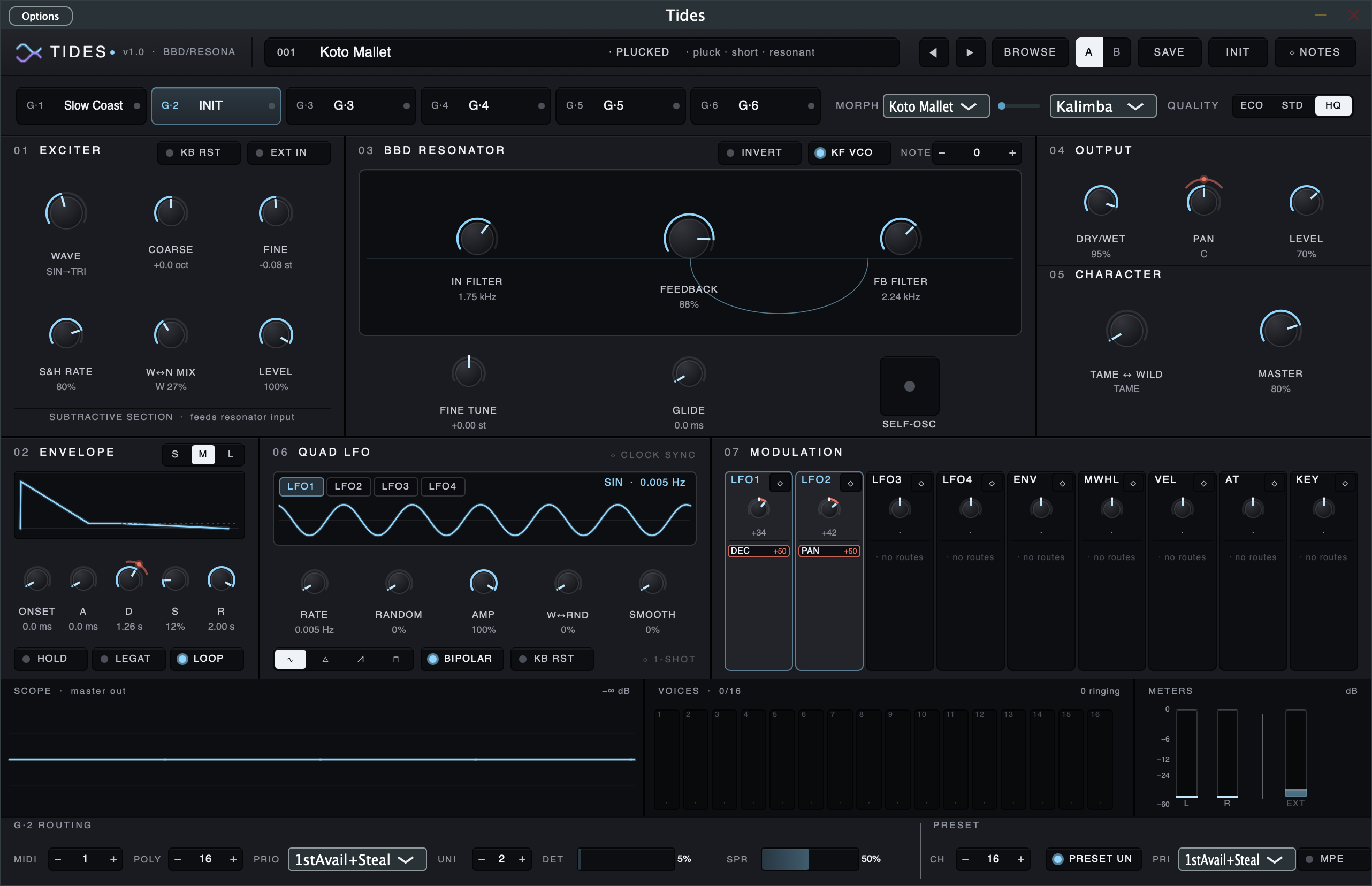
Tides
I’ve always had a soft spot for instruments that aren’t quite filters and aren’t quite synths, the ones that resonate and sing.
Karplus-Strong plucks, self-oscillating ladders, comb filters fed back into themselves until they tune. There’s a particular character to a resonator being excited rather than a waveform being filtered, and after the St. Barts Reverb plugin I wanted to spend some time chasing it.
Tides is the result. A free polyphonic synthesiser (Standalone, VST3, AU) built around a bucket-brigade-style resonator, with six voice groups, a fully patchable modulation matrix, MPE support, and 33 designed factory presets. I built some early prototypes in Max, and you can hear the results all over my Beyond the Beyond EP.
I’m working on some walk-through videos and audio demos, but for now here’s the lowdown (keep reading for the download link):
BBD
A BBD (bucket-brigade device) is an analogue chip that shuttles a sample of audio along a chain of capacitor “buckets” once per clock cycle. It was the secret behind a lot of late-70s chorus, flanger and analogue delay pedals that are short, lossy, warm, with a soft top end that took on a life of its own when you fed it back into itself.
If you take that delay-line behaviour, set the loop length to a musical pitch, feed it a short burst of energy from an oscillator or noise source, you get something that rings like a string and decays like a hall. Then crank the feedback up another notch and the resonator self-oscillates and it stops needing the input at all, and you’ve got a polyphonic singing voice that follows the keyboard.
That’s the instrument - an exciter, a feedback loop, and the dance between them. Everything else in Tides is in service of making that path expressive and playable.
┌───────────┐   ┌───────────┐   ┌───────────┐   ┌────────┐
MIDI → │  EXCITER  │ → │ RESONATOR │ → │  OUTPUT   │ → │ MASTER │ → out
       └───────────┘   └───────────┘   └───────────┘   └────────┘
              ▲              ▲                ▲
              └─── modulation matrix (9 sources × everything) ───┘
How it works
The exciter
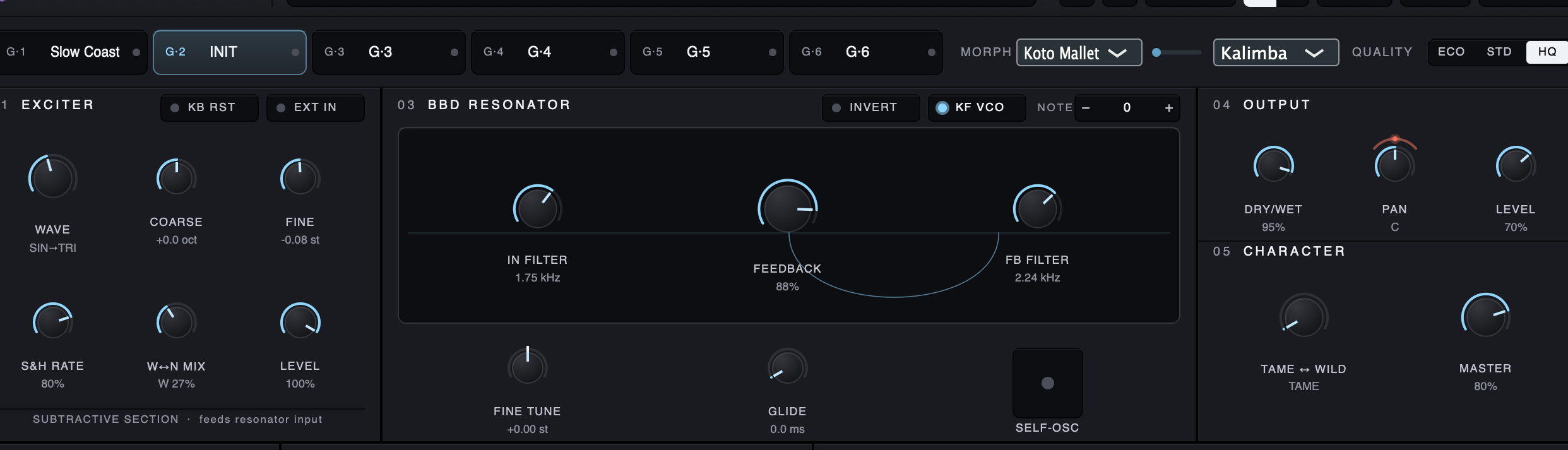
The exciter is where the energy comes from. You turn the Wave knob for a continuous morph through five waveforms (sine → triangle → ramp → pulse → square), crossfaded against a noise generator with a sample-and-hold rate of its own.
A short, plucky envelope gives you Karplus-Strong-style strings whereas a long sustained envelope into the loop gives you a bowed pad.
The exciter is also routable to an external audio input, so you can run guitars, vocals, anything you fancy through the resonator. Seriously, try singing into it.
The BBD resonator
The resonator is the heart of the instrument. It’s a delay line tuned to the note’s frequency, with three controls:
- Input (IN) filter - How much of the exciter actually reaches the loop. Pull it down to keep bright sources from screaming.
- Feedback - How resonant the loop is. At 0, you hear a single tap. Around 0.5, you’ve got a tuned reverb. Past about 0.85, the loop self-oscillates indefinitely; the exciter becomes optional.
- Feedback (FB) filter - A tilt in the feedback path. Higher = brighter, longer rings; lower = the energy decays into softer overtones each pass.
There’s also a Wild/Tame dial that modulates the loop’s internal noise floor, drift, per-voice detune and soft-clip drive. Set to fully tame, you get a clean precise model. Pushed all the way to wild, you get something that breathes, drifts and occasionally overshoots, emulating a piece of analogue hardware that’s been around for a while.
Modulation, properly
Modulation is the bit that makes a synth feel like an instrument rather than a calculator.
Tides has nine sources (four LFOs, the envelope, velocity, key-follow, aftertouch, mod wheel) and every continuous parameter can be a destination, including the preset morph slider. Each source has a master macro so you can sweep everything that source is driving from a single knob.
I built a click-to-assign workflow so you can patch without ever leaving the panel.
Tap a source tile to arm it, then click any knob on the synth. A connection lights up at +50% depth. Click the same knob again and it bumps to +100%, then back down through zero to -100%. A little triangle-wave traversal of the whole range from one gesture.
Every modulated knob shows a coloured arc around its bezel for the modulation’s excursion, and an animated dot riding along where the live value currently is.

Voice groups
A voice group in Tides is a complete synth - its own patch, its own MIDI channel, its own polyphony.
There are six of them. You can layer all six on channel 1 for an absurdly thick stack, split them across channels for a multi-timbral rig, or focus down to just one and use the others as silent variation slots.
There’s a preset morph slider that takes any two presets as endpoints and crossfades the focused voice between them meaning that all 20 continuous parameters, all LFO settings, all macros interpolate at sample-block rate.
Mod connections survive the morph, so you can build a patch where the modulation routing is fixed and the entire underlying sound morphs around it.
Quality switch
Resonators are nasty to oversample naively. Feed them aliasing and they ring it back at you forever. There’s an Eco / Std / HQ quality switch on the group bar: 1× / 2× / 4× internal upsampling around the feedback loop. Eco is great for live work whereas HQ is for mixing and gives you noticeably cleaner top-octave behaviour. Switching is live; the engine crossfades the new sample-rate state over a few milliseconds.
MPE
Admittedly untested with a real MPE controller, but lower-zone MPE is in there (though not tested properly). Per-note pitch follows the slide. Per-note pressure routes to the AT modulation source so you can map it to anything, including feedback amount, Wild/Tame, resonator pitch, dry/wet, whatever you need.
Channel-mode MIDI works fine if, like me, you don’t have an MPE controller.
Design notes.
There are 33 factory presets across eight categories: plucks, pads, self-oscillating tones, basses, bell/metallic textures, strings, glitchy random things, and multi-voice layered stacks. Each one ships with designer notes explaining what technique it’s showing off.
The next iteration will focus on some better presets as these were a bit rushed. You can get some amazing sounds with some interesting modulation settings and I keep meaning to replace some of he more stale presets. As always, time…
Download
Free. Standalone, VST3 and AU. macOS, Apple Silicon.
The download includes a quick-start README and two PDFs — a friendly user guide and an exhaustive parameter reference (including all the expected quirks like the LFO knobs visually freezing during morph mode).
Installing on macOS
The build is ad-hoc signed, not notarised, and the files pick up macOS’s download quarantine on the way to you — so macOS will block them on first open until you clear it. This is expected.
- Unzip and copy the components to:
- AU →
~/Library/Audio/Plug-Ins/Components/Tides.component - VST3 →
~/Library/Audio/Plug-Ins/VST3/Tides.vst3 - Standalone → wherever you like (e.g.
/Applications)
- AU →
- Clear the download quarantine. Open Terminal and run, adjusting paths if needed:
 xattr -dr com.apple.quarantine ~/Library/Audio/Plug-Ins/Components/Tides.component
   xattr -dr com.apple.quarantine ~/Library/Audio/Plug-Ins/VST3/Tides.vst3
xattr -dr com.apple.quarantine /Applications/Tides.app- First launch of the standalone: if macOS still warns of an unidentified developer, open System Settings → Privacy & Security and click Open Anyway in the note near the bottom. You only do this once.
- In your DAW, rescan the plug-in list if Tides doesn’t appear.