Rebooting the Brain
Revisiting Brain-Computer Music Interfacing, Ten-Plus Years On
It’s been 11 years since I graduated from the Plymouth University with a PhD in Brain-Computer Music Interfacing.
I left academia at the end of my studies. About to become a parent for the first time, I joined Arm in Cambridge to explore the world of corporate tech.
I always stayed in touch with progress in BCMI. I’m a reviewer for BCI Journal and for Leonardo Music Journal (MIT Press) on things brain-control and music related. But I’ve not touched the actual tech-side of things since 2015.
Hearing the past
Recently, a friend told me they stumbled across a radio show I produced for American station WFMU.
I’d almost forgotten about this so I gave it a spin as I had no real memory of what it was about.
Having over 10 years of separation gave me a completely fresh perspective upon hearing it back. I clearly put some effort into it as it covers not only my research but the whole field and history of brain-computer-music interfacing. It was like looking back into my world from about 3 versions of me ago.
You can check it out here:
The point of closure
When I finished my studies I felt like I’d achieved all I set out to do, and more.
I stared so much at the flashing SSVEP stimuli I was using and constantly experimenting I think my eyesight took a permanent hit. By the end I was able to precisely control sounds and music with that technique and I went further and experimented with different BCI paradigms (including motor imagery, affective response) to mixed.
I performed and presented my work around the world - from California to Stockholm, from Marseille to Berlin and beyond.
What’s more I tested my systems with patients from the Royal Hospital of Neurodisability - they performed concerts for their friends, family and hospital staff behind closed doors.
Seeing the impact of what was really a proof-of-concept from the reception these concerts had genuinely emotional and validated the years of sweat and tears I’d put in - something quite rare in doctoral research.
That final concert at the hospital gave me a real sense of closure with my studies in this area. With big life changes looming, I felt like I was ready to see others come and take what little I’d started into new and innovative directions.
Here’s a clip from a rehearsal of our brain-quartet performance:
When I left academia, BCI in industry wasn’t really a thing. Since then Vice President Musk’s Neuralink venture took off, and even Meta joined the fold. But I’ve actually seen very little in the way of developments in BCI for music control.
The price of entry
When I was performing with a BCMI, the hardware I used cost approximately £18K for one performer. With the hospital brain quartet, that cost can be almost quadrupled.
At Plymouth, we were fortunate to have a commercial partner, g.tec, who sponsored our research, covering the cost of EEG hardware. All the software was custom stuff I wrote myself beyond some Matlab libraries for processing.
Cheaper “prosumer” and open-source “research” BCI kits available. But for reliable EEG readings and for performing at concert venues that have a lot of electrical noise and interference they’re really not suitable for actual brainwave control (trust me, I’ve tried them).
Fast-forward to today, and the more established medical-grade research gear companies are starting to step down in the top-end of “prosumer” research setups.
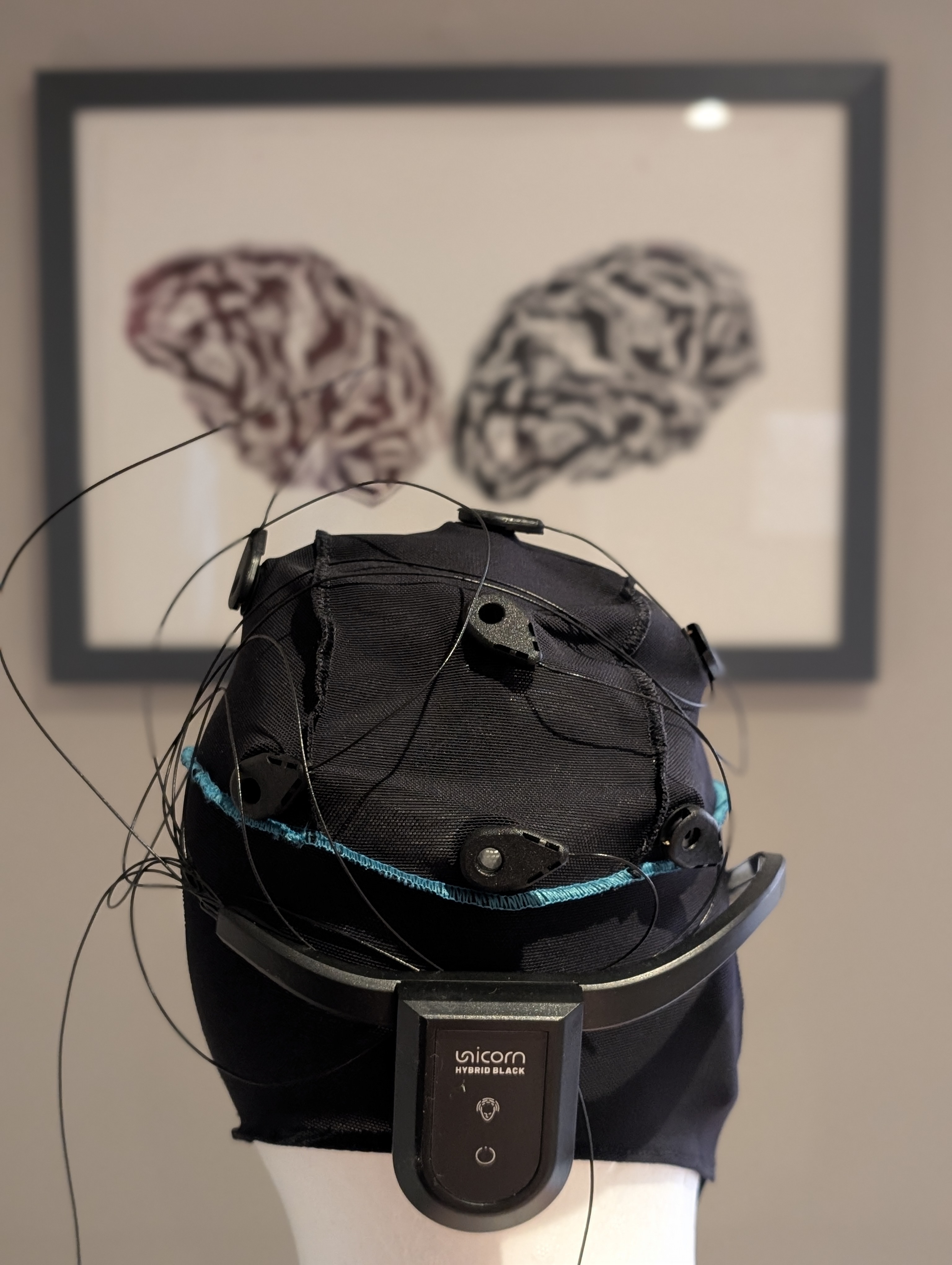
The g.tec Unicorn Hybrid isn’t quite the robust and accurate £18K suite of products I was used to, but a potentially usable platform at a £1.2K price point was tempting me for quite a while.
A fresh perspective
Well I’m not studying to pass a doctoral submission and viva these days, so why dig up something I left behind long ago?
I had one of the best experiences of my life during my PhD.
Having the space and support to self-study and focus on a specific area within a field opened my mind in ways previously unimaginable. It instilled in me a practice of real discipline and critical rigour. And it gave me confidence in myself from having a safe pace to fail.
Furthermore, being part of a thriving research group of likeminded music nerds gave me lasting friendships and a community with others as we shared something unique together in that lab in Devon that we called home.
So why go back (cerebrally, not geographically)? Romantisicm aside, I loved making those systems. The whole process of putting the compositions and the software and all the interconnected things together. The magic when something finally works is amazing. No one shares that with you (and they don’t need to), it’s a solitary sense of achievement and fulfilment.
So fast forward to today. I bit the bullet and bought the Unicorn system. This really is starting again, from scratch - but this time for pleasure. To explore what’s possible and what’s not. I have some ideas of exploration, and who knows what will come from it - watch this space.
The Unicorn has no software for macOS. And I’m not in the running for spinning up a Windows WM, so it’s back to build/hack your own software time. The data acquisition, the signal processing, the feature extraction, the stimuli and feedback interface, the mapping systems, the music connectors, then the music itself. It’s going to be long and slow, but boy it’s going to be fun.
Having typed all of this out, I’m not really sure what this blog post is saying, but like all of them really it’s a note to a future self to reflect back on.